CSotD: Farther’s Day
Skip to comments
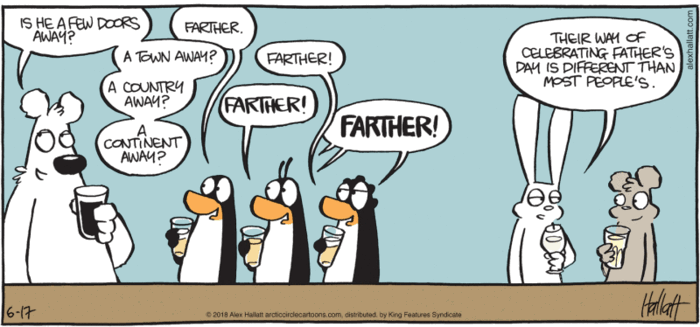
Alex Hallatt may have just been going for the pun in today's Arctic Circle, but it struck me another way, which is one of the perils of cartooning.
In 2007, I wrote a newspaper serial story for the New York News Association, a piece of historical fiction set in New York City in the 1890s and patterned on Horatio Alger and the other dime novels of the era. As with those pieces, it featured a plucky honest lad who impresses someone with his character and is thus elevated out of poverty.
The main character lived with his mother and baby sister in a tenement because his father had gone West and, after sending back money for a time, disappeared, leaving them scraping by on the mother's sewing. But the person he impressed was a newspaper editor, and the plucky lad becomes a copy boy and occasional reporter at the paper.
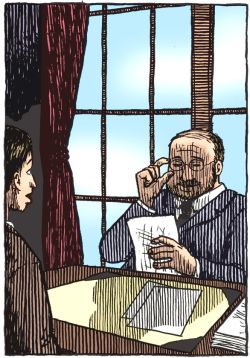 In the last chapter, the editor calls him into the office because they've received a "Help me find my family" advertisement — not an uncommon thing in the 1800s — from someone who is clearly his dad (illustration by Christopher Baldwin).
As the story ends, the boy races off to be reunited with his father, and, in the essay contest that went with the story, we asked kids to write the next chapter.
We were expecting far-flung or practical explanations for why the father had been unable to contact his family, but, instead, we were confronted with the fury with which, in these kid-written final chapters, the plucky lad confronted his absent father.
The kids barely touched on explaining the mixup and, instead, unleashed their bitter feelings about abandonment.
We were a bit stunned.
A young reader once asked me why so many kids in these stories are orphans, and I replied that, if they had supportive families, they would probably avoid some of the situations they get into and they wouldn't have to figure out solutions on their own and so the stories would be kind of boring.
In this particular case, Tommy wasn't an orphan, but his mother was so overwhelmed that he ended up taking a lot of responsibility on his young shoulders, and I think too many of the kids were able to identify with that.
Which ties into a conversation I had recently.
I can only think of one divorced family from when I was a kid. A quarter of a century later, my oldest son's best friend's parents got divorced and we took him to see "Kramer vs Kramer" in hopes of sparking some dialogue on the topic.
But by the time we split up a few years later, so many of his friends were divorced that he was hardly alone, and now his granddaughter has just been born into a world where divorce is such a normal event that it's almost not worth discussing.
What has, I think, remained the same is that some parents are present and some parents never were and I'm not sure how much that has to do with whether they all live in the same house.
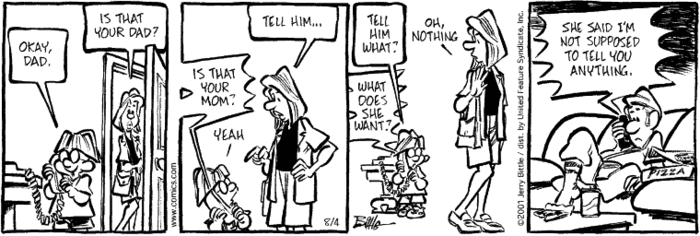
When Jerry Bittle was preparing to launch Shirley & Son in 2000, we had some back-and-forth because I didn't want one more dad-bashing strip in the paper.
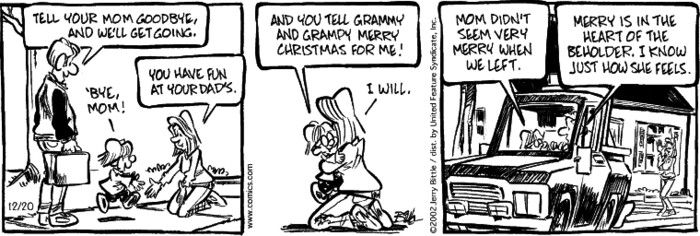
As it turned out, the strip was a very sympathetic and realistic, though often hilarious, look at the situation, with little Louis just young enough to not quite know how things worked, and his dad suddenly forced to deal with things he'd left up to Mom, but only by default, not through a character flaw.
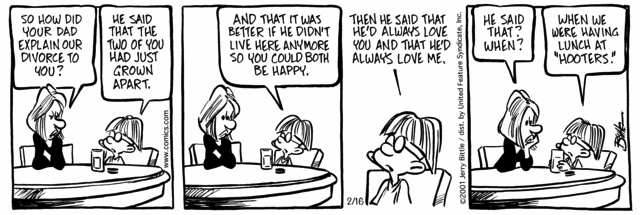
Well, maybe a little character flaw.
I was sorry to lose a friend when Jerry died in 2003, but I was also sorry to see Shirley & Son end, because it was really gaining its feet and the family was just settling into whatever they were going to be. I wanted to see more of what that was.
 That was 15 years ago, and I think cartoonists need to update their game.
There are some cartoons that seem in touch with the modern family, though the two that comes to mind first aren't on the page much anymore, Stone Soup having gone to Sunday-only and Dykes to Watch Out For having ended its run.
There are, however, too many strips stuck in the "Dad is a clueless idiot" mode that, first of all, signals a sort of normalcy to that and, second of all, I don't think accurately reflects a large portion of the young men who are becoming fathers these days.
Women can drive without crashing and they can balance their checkbooks, and, similarly, guys know how to be fathers.
 I'm seeing a lot of fathers who are comfortable in the role. When they take their kids to the park or out to run errands, they don't act as if there's anything extraordinary in it.
And if the kids sometimes run wild, I've seen them do that with Mom, too.
 This isn't just a case of new, self-conscious hipsters. It is a strong trend among professional athletes, beginning back when one of them said in a post-Super Bowl interview "This is the greatest day of my life, except for when my daughter was born."
A sentiment so often heard that I can't remember who said it then.
It's a new world.
 I'm hoping that, when today's tinies are 11 and 12, they'll be able to come up with exciting, imaginative reasons why a loving father might have temporarily dropped out of sight, because it will seem so unusual to them.
Meanwhile
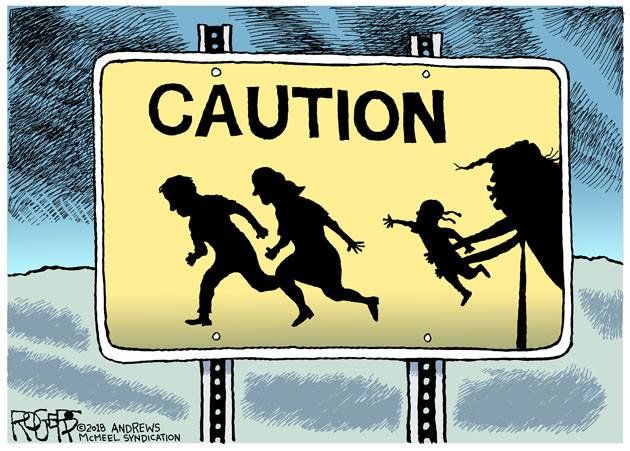 (
(Father's Day is a good time to emphasize the fact that decent people do not purposely separate children from their parents.
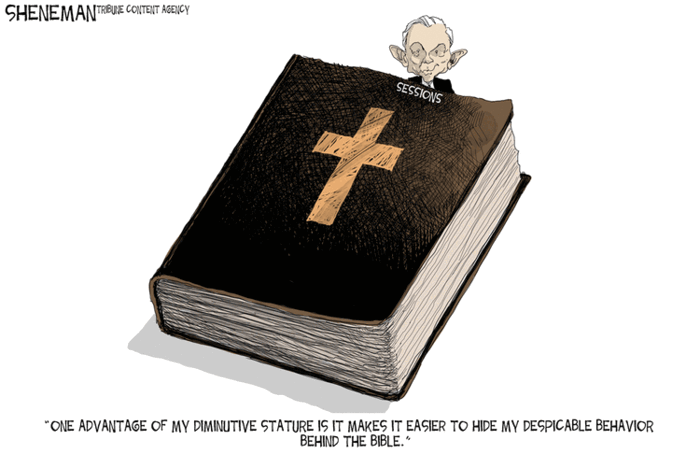 (
(And that there probably isn't a special place in Hell for people who oppose Dear Leader, but if there is a Hell at all, it's surely got a place set up for anyone who quotes the Bible to justify unnecessary, hateful cruelty.
Mike Peterson has posted his "Comic Strip of the Day" column every day since 2010. His opinions are his own, but we welcome comments either agreeing or in opposition.
Comments