CSotD: Friday Funnies
Skip to comments
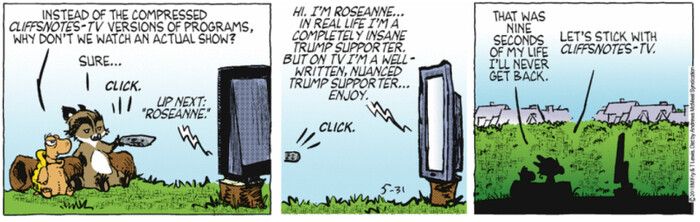
Timing is everything in humor and, with a hat tip to DD Degg at The Daily Cartoonist, here's one I missed yesterday — an Over the Hedge written two weeks ago — and here's Michael Fry's commentary on the serendipity.
That was cool. Now do it again.
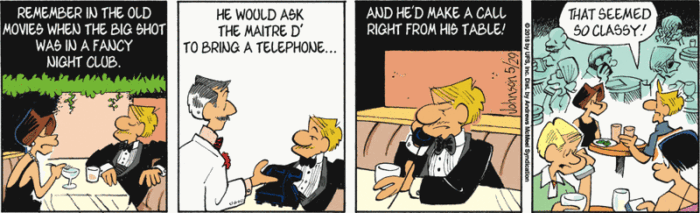
Arlo & Janis offers a look at the gracious past, and their timing isn't bad either, since I have just, as promised, gone back to a flip phone.
The ubiquity of cell phones that Arlo bemoans came a lot faster than I expected, and apparently moreso in every other country but ours, largely because it's easier to connect to towers and satellites than to string cable or fiber for the Internet.
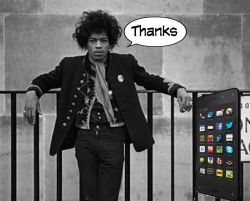 Aside from the "hang up and talk to each other" aspect of all those cell phones, there's also the point that the difference between the tiny screen on my flip phone and the larger screen on my Fire is only interesting in terms of reading pure text.
The Fire is superior for text, and for letting people stand next to it, but it's not very good at all for anything that combines text and graphics.
Screen size is all but irrelevant: Books are better when the pictures in them matter.
And, by the way, you can't bitch about newspapers shrinking the comics if your solution is to shrink them yourself.
Not much of which has a lot to do with Arlo's point, which is that yapping over the phone while you're at dinner is the opposite of classy.
I know people who shut off their phones during meals and who, before there were cellphones, did not answer the one on the wall while they were eating.
They appear to be a distinct and shrinking minority.
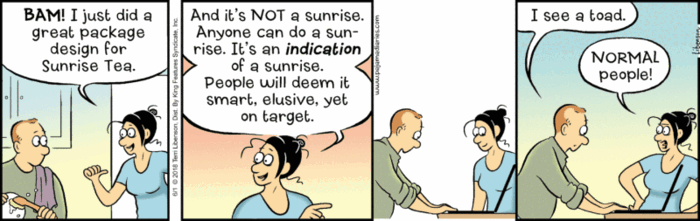
Today's Pajama Diaries made me chuckle, sigh, and shake my head.
There's such a thing as being "too smart for the room," but there's also such a thing as being "too subtle for the room," and one thing you learn in advertising and marketing is that you shouldn't be either.
It's hard to be Toulouse-Lautrec and come up with advertising posters that go down in art history as "smart, elusive, yet on target" and also sell the product.
Though you could be Andy Warhol, taking the graphics that already sold the product and declaring it great art.
As for the arrow in the FedEx logo, I'm perfectly willing to believe that, once he saw it, the designer emphasized and exploited it, but my guess is that he was goofing with typefaces when it fell into his lap. (Which, when I searched for a link, I discovered was not only pretty much true but a fascinating example of knowing when to leave things alone.)
I was admittedly never quite cynical enough to cut it in advertising, but I do know that "I Can't Believe I Ate The Whole Thing" became a national catch-phrase without selling a whole lot of Alka Seltzer, and that, among the clever ads they used to show during the Super Bowl, there were some bankrupt clients. The stories can be amusing if you aren't one of the victims.
Anyway, first things first: Please the client and cash the check.
Do smart, elusive, yet on target things on the weekend and feed the family Monday through Friday.
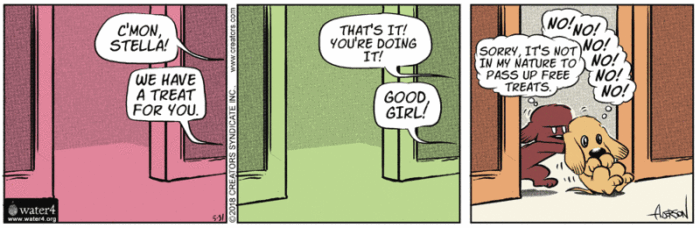
 As noted here in 2016, the original Sophie who inspired the dog in Dog Eat Doug passed away, but it appears from the strips since that Brian Anderson and family have begun fostering adoptable dogs. Bringing them into the strip has been a good way to keep things fresh.
This past week (starting here) introduced a very shy pup, which was not only good fun but somewhat familiar, for better or worse.
The "for worse" is that a lot of adoption groups put forth the idea that a fearful dog has been abused, which adds to the pity factor but ignores the point that dogs have distinct personalities.
Adopting a dog because you feel sorry for it is an admirable motivation, but makes it risky to assume that you'll end up with a well-balanced, happy companion.
The "for better" is that some dogs really do just need some healthy exposure. We've got a tiny thing — possibly a Jack Russell/Chihuahua mix — who started coming to the park as a very young pup and, like Stella, was afraid of everything.
Three months later, she's still not the first to greet you, but she doesn't shy away anymore and she's very quick to leap into the dog games the others are playing.
"Shy" can sometimes — maybe even "often" — be overcome with patience and exposure. "Fearful" has a less optimistic prognosis.
The people who run adoption programs should be able to distinguish between them and advise people accordingly.
Oh, and, relative to the above strip, the other dogs are well-aware that she gets a treat for coming.
When she is called, a crowd gathers.
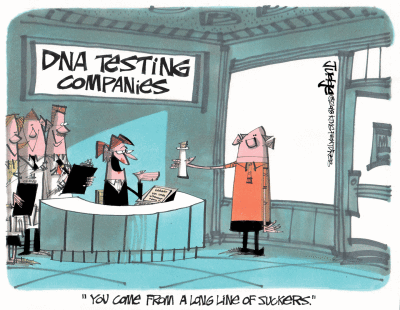
Which easily leads to this Lee Judge panel, the connection being that DNA testing for dogs is limited by the number of breeds for which the companies have genetic profiles.
So you drop $125 to find out what your adopted mutt is made from and the answer comes back 25 percent Lab, 25 percent beagle and 50 percent "other," which you could have figured out by looking at the dog.
Those who process human genes seem to have more detailed libraries, but the ads that show people being astonished rarely have them say, "I never knew our milkman was Italian!"
Anyway, even without that kind of surprise, we're bigger mutts than our dogs.
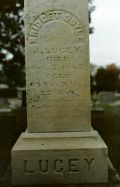 My Irish great-great-grandmother was a Doyle, which means there's a chance I'm slightly more Danish than I thought, or maybe a tad Norwegian.
"Doyle" is a Viking name, but those genes entered the pool a thousand years ago.
So I doubt great-great-granny ever made lutefisk, nor would have willingly eaten it, despite those stray Norse elements in her genome.
Mike Peterson has posted his "Comic Strip of the Day" column every day since 2010. His opinions are his own, but we welcome comments either agreeing or in opposition.
Comments 5