CSotD: Mean Kids Triumphant
Skip to comments
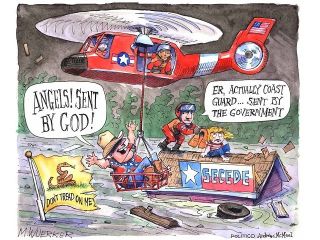 I didn't use this Matt Wuerker cartoon the other day, but not because I thought it was unfair.
Wuerker has been through a ghastly, unfair gauntlet of on-line and media pile-on bullying, an explosive wave of toxic stupidity that should appall decent folks, if there are any left.
I didn't do all the digging required to find out who first alerted the humorless troll brigade, but a quick Google search lists Breitbart, Town Hall, the Washington Times and a number of other far-right screed sheets, all wetting themselves in horror over the piece.
At the Washington Post, Michael Cavna has a write-up about the lynch mob scene, which, by the way, was also represented in Washpo by a horrified column that reflects a too-delicate approach to political cartooning.
And then Wuerker was chased around on Facebook by some deeply sincere people who were furious that he didn't depict African-Americans who don't like being shot by police. So I guess he won't be invited to the next cross-burning.
I normally question labels in cartoons, on the theory that, if you have to use a label, your graphics didn't explain it clearly enough, but here the labels were important, and quite clear.
Except that political cartoons assume an audience that understands satire, and using labels assumes a literate audience, and Wuerker ran into a mob that apparently doesn't fit either category.
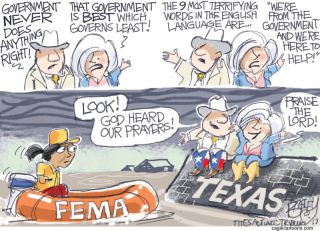 The really weird part of all this is that the reason I didn't use Wuerker's piece is that it was only one of several cartoons making the same point and I chose a different one. Actually, I used a couple over the past few days that made the same point.
I used Pat Bagley's because he was first, and because he used a multi-panel approach that laid the matter out with a great deal of clarity, though, if he'd pushed a little harder, I might have passed it up as hammering the point too hard.
There's a line between being clear and being tendentious, and, like porn, it falls into that nebulous category of "I know it when I see it."
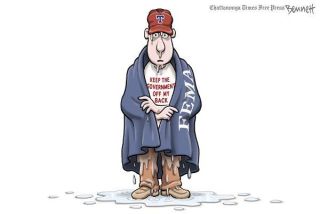 At the other end of that scale was the Clay Bennett piece I also used, which I noted was more understated.
As I said then:
I like his version because it doesn't seem partisan or triumphalist. There are a number of cartoons on the same topic that carry an air of "Ha ha — now look at ya!" which are certainly within the bounds of fair expression and free speech and all but perhaps strain at the edges of good taste. … Bennett manages to make the point, but to offer a little sympathy for the True Believers who find themselves in trouble.
I'd stand by that, but the piling on that Wuerker suffered was unfair and uncalled for, because — as noted in my earlier postings — there were a number of cartoons on the topic and, if I didn't use his, it was because it didn't particularly stand out.
I'd be more sympathetic to his attackers if they had jumped on three or four of those similarly-themed pieces. I wouldn't agree, but I'd be more respectful of their point of view.
There was no reason to single out Wuerker's piece. It was lazy and stupid. It would have taken the rightwingers all of 10 minutes to load up a basketful of cartoons on the topic of anarchists wanting government help, with which they could have launched a much more effective attack on the idea.
 And I wish it were only the rightwing anarchists and their lunatic fringe followers who engage in these lazy mean-kid pile-ons.
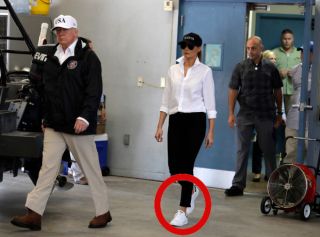
I remain gob-smacked at cartoonists on the left who can't come up with anything more to criticize Trump over than that his wife wore high heels in a disaster zone.
Which she didn't.
Come on, folks: You're getting paid for this. Do your homework.
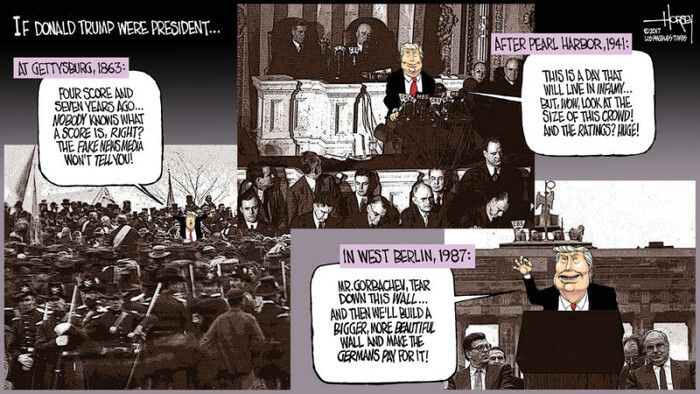
By contrast, here's David Horsey's cartoon-and-commentary, in which he hits Trump on two levels, one being his absurd inability to stay on message and the other being his astonishing degree of egocentricity.
It reminds me of Richard Thompson's classic "Make the Pie Higher" mashup of George W. Bush's mangled speechifying, and Horsey mentions W in his column:
When on script, Trump’s voice is bland and passionless. When he is talking off-the-cuff, he cannot resist slipping into self-congratulation, braggadocio, insults or threats. Presidents do not all have to be articulate speakers. Dwight Eisenhower was hardly a great orator and George W. Bush sometimes had trouble finding his way to the end of a sentence. But, whatever their verbal skills, Bush and Eisenhower and other presidents found their individual ways to project a sense of engagement in endeavors greater than themselves.
Horsey's audience at the LA Times gets both his cartoon and his column — if they can wade through the pop-ups, hover-overs and autoplay barriers that TRONC erects over all content — but even without that textual elaboration, the cartoon itself is clear and fair.
And the difference between W's good-natured bafflegab and Trump's egotistical bloviations is a pretty good yardstick of how the tone of our conversations has changed in the past decade and a half.
In case the level of toxic on-line bullying hasn't provided a hint.
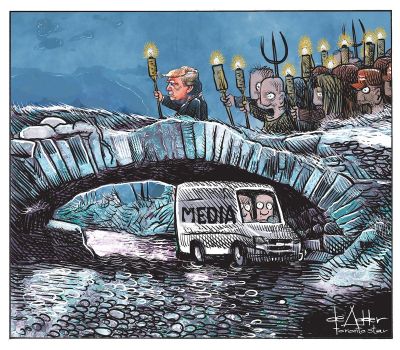
This Michael de Adder cartoon is a few days old, but it's an important warning that dictators begin by stifling voices that oppose them.
There have already been some physical attacks on reporters at white supremacist rallies and, while news outlets struggle to be fair, they must recognize that "fairness" doesn't mean giving in to the mean kids and the bullies.
The rule has always been, "If you don't want to see it in the paper, don't say it."
Damn good rule.
Now here's your moment of zen:
(In searching for "Make the Pie Higher,"
I came across this. God, how I miss him!)
Mike Peterson has posted his "Comic Strip of the Day" column every day since 2010. His opinions are his own, but we welcome comments either agreeing or in opposition.
Comments 1